
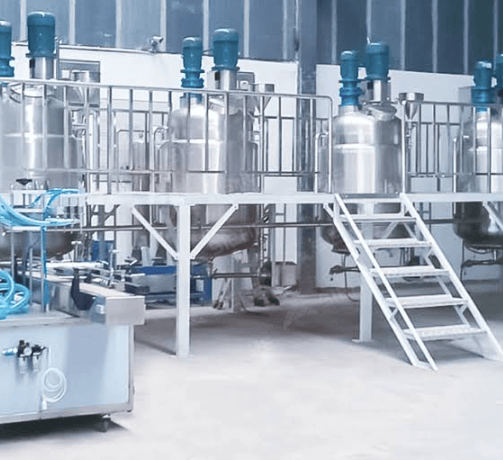


Automating liquid product filling has become a near-universal requirement for manufacturers scaling up production of household and industrial cleaning products. As demand grows and margins tighten, relying on manual filling processes simply can’t keep pace with the throughput, consistency, and hygiene standards that modern retail and industrial buyers expect.
The Core Challenge of Liquid Filling
Unlike solid or powdered products, liquids present unique filling challenges related to viscosity, foaming, and accurate volume control. Detergents in particular vary widely in thickness, from thin, watery formulations to thick, gel-like concentrates, and a filling system needs to accommodate this variation without sacrificing fill accuracy or production speed.
Foaming presents an additional complication specific to detergent products, since the surfactants that make these products effective at cleaning also tend to generate foam during high-speed filling, potentially leading to inaccurate fill levels or product waste if the filling system isn’t properly designed to manage it.
How Modern Filling Systems Address These Challenges
A well-engineered liquid detergent filling machine typically incorporates adjustable filling speeds and nozzle designs specifically suited to viscous, foam-prone liquids, allowing operators to fine-tune the filling process for different product formulations without requiring extensive mechanical modifications between production runs.
Volumetric and gravimetric filling methods each offer distinct advantages depending on product characteristics. Volumetric systems, which measure fill volume directly, tend to work well for consistent, lower-viscosity products, while gravimetric systems, which measure by weight, often provide better accuracy for thicker or more variable formulations where volume alone doesn’t reliably correlate with fill weight.
Integration Into a Complete Production Line
Filling represents just one stage in a broader production process that typically includes bottle unscrambling, capping, labeling, and packaging. Manufacturers evaluating filling equipment should consider how well a given system integrates with upstream and downstream equipment, since mismatched line speeds between stages can create bottlenecks that undermine the efficiency gains the filling system was meant to deliver.
Modular production line designs have become increasingly popular precisely because they allow manufacturers to scale capacity incrementally, adding filling heads or adjusting line configurations as production volumes grow, rather than requiring a complete system overhaul each time demand increases.
See also: Health Topic Discovery Hub About Tuzofalotaniz Calories Exploring Nutrition Discussion
Hygiene and Cleaning Considerations
Detergent manufacturing facilities need to maintain strict hygiene standards, both to protect product quality and to comply with regulatory requirements in many markets. Filling equipment constructed from stainless steel and designed for easy disassembly and cleaning between production batches reduces contamination risk and simplifies compliance with sanitation protocols.
Choosing the Right Equipment Partner
Given the technical complexity involved in liquid filling, manufacturers benefit from working with equipment suppliers who understand the specific challenges of detergent formulations, rather than generic liquid filling providers with limited experience in this product category. Requesting case studies or references from similar production environments can help validate a supplier’s relevant experience before committing to an equipment purchase.
Conclusion
Liquid detergent filling equipment has evolved considerably to address the specific challenges of viscosity variation and foam management inherent to these products. Manufacturers that invest in well-suited filling technology position themselves to scale production efficiently while maintaining the consistency and quality standards their customers expect.
FAQs
Q1: How do manufacturers handle foaming during high-speed detergent filling? Specialized nozzle designs and adjustable fill speeds help manage foam formation, allowing accurate fill levels even with foam-prone formulations.
Q2: What’s the difference between volumetric and gravimetric filling? Volumetric filling measures by volume and suits consistent lower-viscosity products, while gravimetric filling measures by weight, offering better accuracy for thicker or more variable liquids.
Q3: Why is modular line design important for detergent manufacturers? Modular designs allow manufacturers to scale production capacity incrementally as demand grows, without needing a complete equipment overhaul.